


Building a UK battery storage powerhouse
When EIG spun Fidra Energy out of West Burton Energy, it was betting that scale would become the defining factor in UK battery storage. By Nick Herbert.
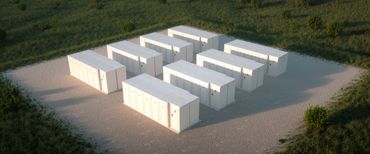
With a 3.15GW pipeline already in hand and ambitions to reach 10GW across the UK and Europe by 2030, Fidra, the Edinburgh-headquartered developer, is backing its thesis with capital and conviction.
The spin-out came in August 2024 when US-based infrastructure investor EIG sold the 1.3GW combined cycle gas turbine power station in Nottinghamshire plus the site's 49MW half-hour battery to TotalEnergies for £450m. EIG had acquired West Burton Energy in 2021 from EDF Energy. Fidra is led by Chris Elder, the former WBE head.
"EIG brought me into WBE as CEO in 2021, and we were able to successfully refinance, restructure, and sell that business within three years," explains Elder. "TotalEnergies was keen to buy the operational power station business but not the development business. So, we decided to keep it and rebrand it as Fidra."
Elder stresses that the ambition from the start was always to build a platform, not just pursue an isolated project. "Our goal is to establish a world-class platform to develop, build, operate and optimise large-scale storage assets that provide essential flexibility to electricity systems."
Currently, Fidra is developing the 1,450MW Thorpe Marsh battery scheme in South Yorkshire, the 500MW West Burton C project, and the 1.2GW Bicker Fen 1&2 undertaking in the East Midlands.
Scale as strategy
Fidra's strategic timing reflects a broader evolution in the UK storage market. Early battery projects relied heavily on ancillary services revenue, but larger-scale deployments are increasingly driven by energy arbitrage complemented by capacity market revenues, balancing services, tolling and a growing willingness from lenders to take measured merchant risk.
"Even before Fidra, myself and a number of the team at WBE were one of the first parties to consent and develop large scale batteries in the UK," said Elder. "Looking at traditional brownfield sites with the idea to put a very large battery in there instead of traditional gas plants."
The conviction was rooted in lessons from wind and solar: once a technology matures, scale becomes a competitive advantage. Batteries, Elder argues, have reached that inflection point.
"The idea was that as battery technology matures, larger scale sites would be more attractive and represent something different to investors," he explained. "Batteries have reached the stage where they are bankable."
The characteristics of storage aligned well with existing capabilities within the Fidra team. "Batteries need a commercial angle to be successful, and that plays to our core strengths around commercialising and operationalising flexible generation and storage," said Elder.
Capex reductions have accelerated investor interest. Elder notes that battery costs have roughly halved on a £/kWh basis over the past 12 months. "There's an incredible opportunity in batteries right now with the price of batteries falling," he says. "It also helps that the UK has set out some clear technology targets through the Clean Power Action Plan that targets achieving clean electricity by 2030. Batteries can and will need to be deployed very quickly, so there's a big pipeline of prospects."
Investors are responding to the clean energy challenge. EIG and National Wealth Fund came together to provide equity for Fidra's platform, raising nearly £450m to kickstart development of the Thorpe Marsh project. Fidra raised £445m in equity at a holdco platform level comprising £245m from EIG and £200m from the National Wealth Fund.
"It was the perfect marriage of a party looking for a large but minority equity investor to co-invest with and another party – National Wealth Fund – looking to accelerate battery deployment in the UK to meet the government’s targets," says Elder.
Thorpe Marsh
The platform building process began with WBE acquiring the Thorpe Marsh project from Banks Renewables in 2023. The scheme will be the largest battery storage site in Europe and one of largest globally.
Planning consent for the site, which is ten times larger than the UK's largest operational BESS project, was received in early 2025. Once completed, Thorpe Marsh is expected to be three times larger than any other BESS project currently in operation or under construction in the UK and will have the potential to export over 2 million MWh annually – enough capacity to power up to 800,000 homes during peak hours of electricity demand.
The £594m project financing comprises lending from Santander, ABN AMRO, China Minsheng Bank, CIBC, Deutsche Bank, Investec, MUFG, NatWest, NordLB, Siemens, SMBC, Societe Generale and Standard Chartered, and closed in September 2025.
Elder was pleased with the result: "The project financing process was easier than expected with the debt well oversubscribed and loan margins a little lower than expected," he said. "It was quite extraordinary how much appetite from the banks there was. We had to scale them back quite considerably at financial close."
"The largest single-bank commitment prior to scale-back was around £100m, reflecting both the project's scale and the quality of the sponsors," he said.
Much of the interest came from existing lenders to the battery sector, but there were a number of new names in the mix as well, which Elder believes were partly attracted by the way the project was structured.
The debt financing is structured as a seven-year hard mini-perm with a 15-year tenor and balloon of just under 50% after year seven. The structure allows flexibility for refinancing while ensuring coverage ratios remain robust even under conservative revenue scenarios.
"It allows us to pay down debt over a longer period but still leaves a healthy balloon to be refinanced in year seven," Elder explains.
Thorpe Marsh has five units backed by three revenue floor contracts – two from EDF and Statkraft plus a tolling contract from Octopus Energy. The contracts run for seven to 10 years. One of the units has been left fully merchant and will be covered by an optimisation contract. In March 2025, the project secured a 15-year capacity market award from the UK government commencing in October 2028 that will provide around 10% of the revenues.
The first unit is due online in mid-2027 and the last in late 2027. It has a long-term warranty from the battery supplier.
Charging up
As well as Thorpe Marsh, Fidra is working on its second battery deal, the West Burton C scheme – a site adjacent to the original WBE gas plant. The site had been consented by the previous owner as an open cycle gas turbine, but Fidra reconsented it as a 500MW battery project.
"West Burton C is in a good position," Elder notes. "We've got a grid connection date in October 2027 that is protected under connection reform changes, which offers us an advantage in the sense that we can get megawatts on the system and deploy them whilst other projects face some short-term uncertainty."
The financing and contractual structure for West Burton C follows the Thorpe Marsh template. "Nomura has been appointed as a financial adviser and we're looking to go to the debt market at the beginning of January," said Elder. "We're looking to raise around £200m of debt for a 500MW two-hour project which has a commencement date in 2027. Offtake arrangements to underpin that are currently being finalised."
Further down the pipeline is the 1.2GW Bicker Fen 1 & 2 scheme. Bicker Fen, a greenfield site in the East Midlands with a 2034 grid connection date, is at an early stage. "It represents more of an option for near term expansion depending on the acceleration of our grid connection and market conditions."
The M&A lens
There are plenty of opportunities in the UK with many large-scale projects for sale. Fidra's strategy remains selective, however, focusing on sizeable, commercially viable sites rather than smaller, fragmented projects.
"We're not really interested in schemes below 400MW to 500MW," Elder says. "The challenge is finding opportunities with some geographic diversity, just given the risk around how transmission charges might evolve."
With two big projects in the Midlands under way, Elder is keen to look at opportunities in the north and south of England. "They are probably the two key regions we're focused on," he said. "In terms of M&A, we are looking at some opportunities in Scotland, but right now the economics are not as strong for those projects. On a pure standalone basis, there has to be something unique about those projects to make them attractive to us."
International expansion is on the horizon—Italy and Germany are being evaluated – but Fidra remains focused on the UK in the near term, given its greater grid certainty and the commercial attractiveness of large-scale projects.
Procurement power
Fidra's approach reflects a belief that scale confers advantages in procurement, as well as financing and operations. A competitive battery procurement process for Thorpe Marsh attracted over 15 full offers, demonstrating the attractiveness to suppliers of a project of that size. They were willing to provide favourable commercial terms to get the deal done.
In November 2024, Fidra signed a 4.4GWh energy storage partnership agreement with Sungrow Power that will see the China-based energy storage system provider supply its liquid-cooled energy storage system PowerTitan 2.0 to both Thorpe Marsh and West Burton C. The systems are to be of two-hour duration initially with expansion potential to a four-hour system. Sungrow will provide 20-year technology warranties.
Capital runway
Equity needs will rise with growth, particularly if Fidra moves into new geographies or acquires larger platforms. "When we actually enter another market and put serious capital down, that's when we're going to have to raise more equity," Elder says. Until then, the current £450m fund is sufficient to deliver Thorpe Marsh, West Burton C, and potentially one other near-term project.
Elder acknowledges the ambition of the 10GW target but notes a practical trajectory: "A realistic ability is probably to reach five to six gigawatts in operation by 2030, with a pipeline of projects either in construction or development to get us to the target."
Project financing conditions should continue to improve as the market matures: battery prices fall, projects grow in scale, grid connections become more certain and revenue streams more predictable. Lenders, increasingly familiar with battery economics, are already willing to take on some merchant risk.
"They're comfortable now, because they've got multiple bankable forecasters providing revenue projections," Elder says. "It's no different in principle to investing in a merchant gas plant."
A platform for transition
As the UK accelerates towards its net-zero targets, Fidra's business model – combining scale, disciplined project finance structures, and commercial flexibility – positions the company to capture a significant share of the country's storage buildout. The question is no longer whether batteries are bankable, but who can deploy them fastest and most efficiently.
For Elder and his team, the answer lies in scale. "We're building a platform that can deliver a significant share of the target UK storage capacity," he says. "And we think that gives us a competitive edge in procurement, financing and operations."
Whether Fidra can achieve its 10GW ambition remains to be seen. But with Thorpe Marsh nearing construction and a proven ability to attract both equity and debt at competitive terms, the company has already demonstrated that size matters in the battery storage game.
